Crash game strategy: what actually works, what fails, and the maths behind both
There is no strategy that beats the house edge in Aviator, JetX or any crash game. There are strategies that make you lose slower, lose on your own terms, and stop faster. This guide is about those, with the numbers attached.

Updated 20 October 2026 · Fact-checked by Hamza Qureshi
Most crash game strategy articles list "low-risk", "medium-risk" and "Martingale" as if those were three doors and one had the prize behind it. We play these games every day, with our own money, and the honest version is shorter: nothing changes the expected return, several things change how you experience it, and one of those things (stopping) is worth more than the rest combined.
Everything below assumes you have read how crash games work, or at least know that the crash point is fixed before the round and the game returns 97% over time. If not, start there.
Target selection: why every target has the same edge
Your cash-out target is the only decision you make during a round, so it feels like it should matter most. It matters for variance. It does not matter for expected value.
The chance the plane reaches a multiplier m in a 97% RTP game is roughly 0.97 divided by m. To break even at that target you would need it to reach m one time in m. It reaches it 0.97 times in m. The ratio is 0.97 at every target, which is a 3% loss at every target.
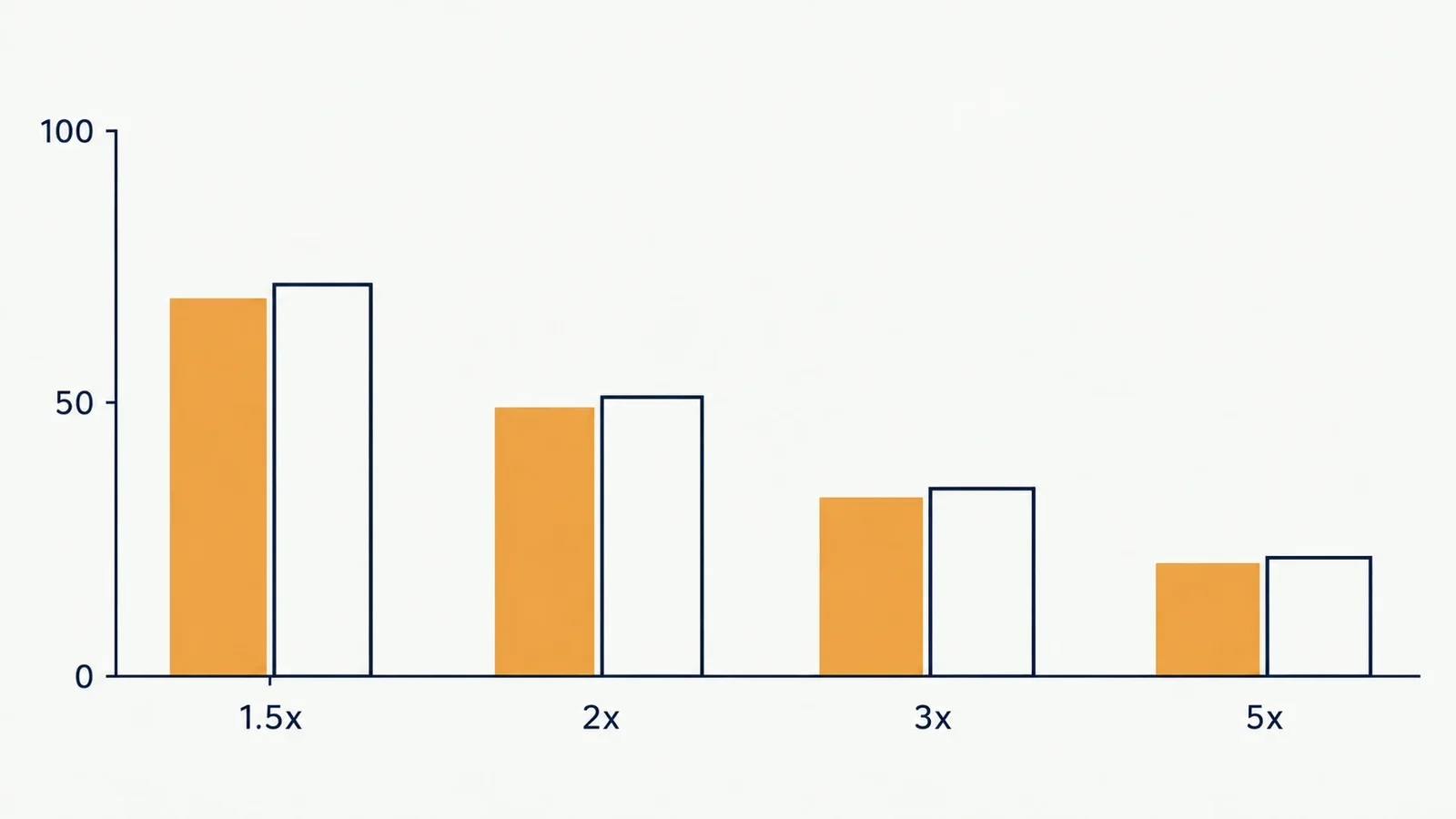 Amber is how often the plane gets there. The outline is how often it would need to. The gap is always 3%.
| Target | Reaches it | Needed to break even | Average result per 100 staked |
|---|---|---|---|
| 1.20x | 80.8% | 83.3% | -3 |
| 1.50x | 64.7% | 66.7% | -3 |
| 2.00x | 48.5% | 50.0% | -3 |
| 3.00x | 32.3% | 33.3% | -3 |
| 5.00x | 19.4% | 20.0% | -3 |
| 10.00x | 9.7% | 10.0% | -3 |
So "low-risk strategy" and "high-risk strategy" are not strategies. They are flavours of the same loss. The real question is which flavour you can sit through without doing something stupid.
Low targets (1.20x to 1.50x) give you a win most rounds and a slow bleed from the 1.00x crashes. The danger is boredom: after forty small wins people raise the stake "because it is working", and then the 1.00x round takes a week of profit. High targets (5x and up) lose nine rounds in ten and the danger is the opposite: a long drought, a feeling you are "due", and a stake increase to catch up. Mid targets (1.80x to 2.50x) are where most experienced players sit, including most of us, because the win rate is close to a coin flip and the sessions are emotionally readable.
Pick one. Write it down. Then set the game to enforce it, which brings us to the next section.
Auto cash-out is the one feature you must use
Auto cash-out pays you at exactly the target you typed, the millisecond the curve reaches it. Manual cash-out pays you at the target plus your reaction time plus your network latency, or pays nothing if the crash lands inside that window.
We measured this on a Zong 4G connection in Lahore across 200 manual rounds at a "2x" target: the average successful cash-out was 2.09x, and 11 rounds were lost that had crashed between 2.00x and 2.08x. Those 11 rounds are pure leak. Auto cash-out would have paid all of them at 2.00x.
It also removes the second-worst habit in the game, which is moving the target mid-round. The curve passes 1.80x, you think "it feels strong", you let it run, it crashes at 1.94x. Auto cash-out does not have feelings. Set it before the round and do not touch the slider while the plane is up.
Flat staking at 1% to 2%
The "1% rule" people ask about is simple: never stake more than 1% of the money you brought to the session on a single round. We allow 2% for short sessions. Either way the stake is flat, the same every round, win or lose.
Two reasons. First, expected loss is stake multiplied by rounds multiplied by edge. Cut the stake and you cut the cost of the hour in direct proportion. 300 rounds at 200 per bet costs 1,800 on average; at 40 per bet it costs 360. Same game, same fun, one fifth the price.
Second, survivability. At a 2x target you lose 51.5% of rounds. Five losses in a row happens about once every 28 rounds, which is every few minutes. Ten in a row happens about once every 760 rounds, which is every couple of evenings if you play regularly. At 10% stakes, ten losses is the bankroll. At 1%, ten losses is a bad patch you barely notice.
Flat staking is boring. That is its entire value. Every progressive alternative concentrates your stake into fewer rounds, and the rounds it picks are chosen by emotion.
Stop-loss and take-profit
A stop-loss is the amount you are willing to lose in a session before you close the tab. A take-profit is the amount you are willing to win before you close the tab. Everyone sets the first. Almost nobody sets the second, and it is the second one that saves money.
Here is why. The house edge is paid on every unit staked. A player who is up 40% and keeps playing is staking their winnings back into a 3% edge, round after round, and over enough rounds the winnings go back. The only way to actually leave with money is to leave. A take-profit is the rule that makes you.
Our numbers: stop-loss at 50% of the session bankroll, take-profit at 50% up. Both are deliberately reachable. A stop-loss of 100% is just running out of money; a take-profit of 300% is a number you will hit once a year and ignore.
Write both figures where you can see them before the first bet. Several operators (Betway and Parimatch among the ones we use) let you set session loss limits in the account settings, which is better than a note because it cannot be renegotiated after a bad run.
The dual-bet "hedge", with the actual numbers
Aviator gives you two bet panels and JetX three. The strategy that circulates on every Telegram channel is: bet A with auto cash-out at 1.50x to "cover" the stake, bet B riding to 3x or higher for "free". It feels clever. Let us run it.
Two bets of 1 unit each. Bet A cashes out at 1.50x, bet B at 3.00x. The plane reaches 1.50x about 64.7% of the time and 3.00x about 32.3% of the time. Three things can happen:
| Crash point | Probability | Bet A | Bet B | Net |
|---|---|---|---|---|
| Below 1.50x | 35.3% | -1.00 | -1.00 | -2.00 |
| 1.50x to 2.99x | 32.4% | +0.50 | -1.00 | -0.50 |
| 3.00x or above | 32.3% | +0.50 | +2.00 | +2.50 |
Expected value: (0.353 x -2.00) + (0.324 x -0.50) + (0.323 x 2.50) = -0.706 - 0.162 + 0.808 = -0.06 units per round, on 2 units staked. That is 3%. Exactly what two separate bets would cost. Bet A does not "cover" anything; it is just a second bet with its own 3% edge, and in the worst case (35% of rounds) you lose both.
What the pattern does change is the shape of the session. You take a total loss on 35% of rounds instead of 68% (the single 3x bet alone), and your best outcome is +2.5 instead of +2. Lower variance, same cost. If that shape helps you obey your limits, use it. Just stop calling it a hedge.
Martingale, and the ten-loss sequence
Martingale is the oldest bad idea in gambling: double the stake after every loss so that the first win recovers everything plus one base unit. In a crash game you pair it with a 2x target, because 2x is the multiplier at which a win exactly covers the chain.
Here is the sequence from a base stake of 10, through ten consecutive losses, which at a 2x target happens about once every 760 rounds.
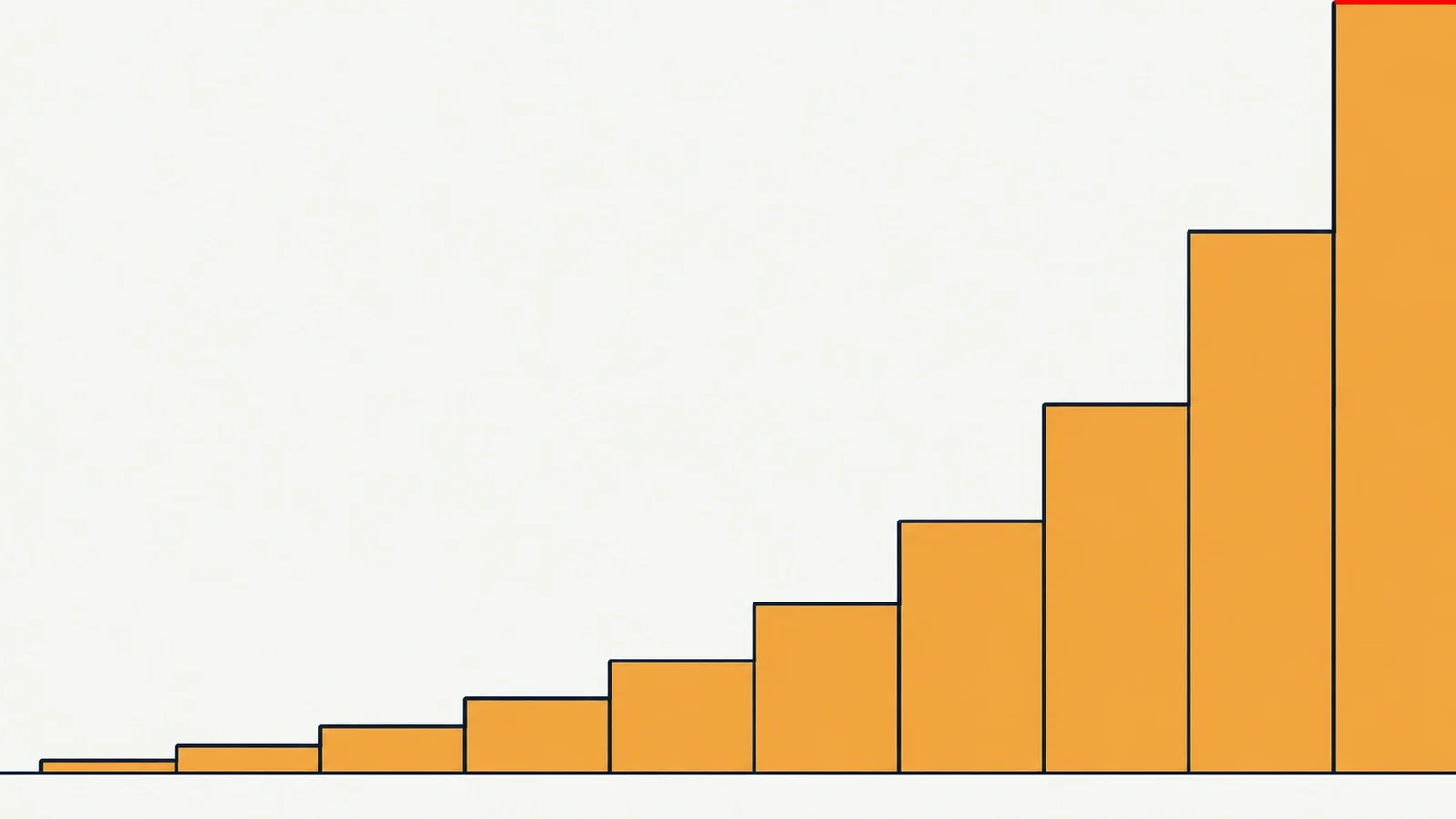
| Loss number | Stake on this round | Total lost so far | Next stake needed |
|---|---|---|---|
| 1 | 10 | 10 | 20 |
| 2 | 20 | 30 | 40 |
| 3 | 40 | 70 | 80 |
| 4 | 80 | 150 | 160 |
| 5 | 160 | 310 | 320 |
| 6 | 320 | 630 | 640 |
| 7 | 640 | 1,270 | 1,280 |
| 8 | 1,280 | 2,550 | 2,560 |
| 9 | 2,560 | 5,110 | 5,120 |
| 10 | 5,120 | 10,230 | 10,240 |
After ten losses you are down 10,230 and the eleventh bet needs to be 10,240, which is 1,024 times your base unit, to win back a profit of 10. Most operators cap a single Aviator bet at 100 to 200 units of currency, so the chain breaks at step four or five on its own. If the cap did not exist, the bankroll would.
And the maths does not care about the chain. Every single bet in it has an expected value of minus 3% of its stake. Doubling stakes does not change that; it just means the losses arrive in one lump instead of a trickle. Martingale converts a slow, certain 3% into a mostly-winning run that ends in a catastrophic, equally certain loss. People who say it "worked for weeks" are describing the first 759 rounds.
The anti-Martingale (double after wins, reset after a loss) fails more gently and more often: you give back the run on the first loss, which at a 2x target is never far away.
"Signals", Telegram groups and prediction
You will be offered signals. A channel admin posts "next round 2.4x+, enter now", a few hundred people bet, some of them win, and the screenshots fill the channel. The misses are deleted. The group has a pinned link to a casino with a promo code, and the admin earns a share of every deposit made through it.
That is the whole business. The crash point is computed from a server seed and three player seeds hashed with SHA-512 before the round starts, and no one outside the game server has the seed. There is no information in a signal. There is a referral link in it. We have a separate guide on the predictor app ecosystem, including the "activation code" scam, which is the same business with an extra step.
A softer version of the same mistake is reading the history strip. Five low rounds do not make a high one more likely, because rounds are independent. "A big one is due" is a feeling, not a strategy.
Session discipline
Strategy in a crash game is mostly about what you do between rounds, not during them.
Time-box the session. Forty-five minutes, then a break regardless of balance. Aviator runs a round every ten to fifteen seconds; an hour is 300 decisions, and decision quality degrades.
Never top up mid-session. The session bankroll is what you brought. If it is gone, the session is over. A second deposit is a new session tomorrow, not a continuation of this one.
Do not play tilted. After a loss at 1.00x with a big stake, close the game for ten minutes. Everyone who has played these games has pressed bet before the next countdown ended, at double the stake, with no target set. It is the single most expensive round in the game.
Collapse the live bets panel. It shows winners. It is marketing. Spribe lets you hide it and we recommend doing so for the whole session.
Keep a log. Rounds, stake, target, result, time. After two weeks the log tells you your real hourly cost, and that number is a better strategy guide than anything in this article.
What we actually do
Since people ask: four of us play crash games most days for this site, usually Aviator, sometimes Chicken Road on medium difficulty, occasionally JetX for the jackpot ticket.
Our standard session is a fixed bankroll in local currency (2,000 rupees, 5,000 taka, 1,500 shillings, whatever we have deposited for that test), a flat stake of 2%, auto cash-out at 1.80x on the first panel, nothing on the second, stop-loss at 50% and take-profit at 50%. We play until one limit is hit or 45 minutes pass. Over a year the log says we lose about 3% of turnover, which is the RTP doing exactly what it says.
We do not use Martingale, read signals or raise stakes on a hot run. Not virtue; we have just run the numbers above enough times to stop arguing with them.
If any of this has stopped feeling like entertainment, our responsible gambling page lists helplines for every country we cover. 18+ only.
Frequently asked questions
What is the best crash game strategy?
The one that keeps you in control: a fixed target set with auto cash-out, a flat stake of 1% to 2% of your session bankroll, and a stop-loss and take-profit you actually obey. None of it beats the 3% house edge. It just means the edge is collected slowly, from small stakes, and the session ends when you decide rather than when the balance hits zero.
What is the best multiplier to cash out at in Aviator?
There is no multiplier with a better expected value than any other. At 1.5x, 2x, 5x or 20x the game keeps about 3% of what you stake over time. Lower targets win often and lose slowly; higher targets win rarely and lose in streaks. Most of our team settles between 1.5x and 2.5x because the sessions are easier to sit through, not because the maths favours it.
Does the Martingale strategy work in crash games?
No. Doubling after every loss recovers small losses until a streak outruns your bankroll or the table limit, and at a 2x target a ten-loss streak comes around roughly once every 760 rounds. By the eleventh bet you are staking 1,024 times your base unit to win one unit. The expected value of every bet in the chain is still minus 3%.
Is the dual-bet strategy a hedge?
Not in the sense of reducing expected loss. Two bets in the same round are two independent wagers with a 3% edge each, so expected loss doubles with the stake. What dual bets do is reduce variance: you lose both bets less often and win big less often. If smoother sessions help you stick to limits, that is a fair reason to use them.
Do Aviator signals on Telegram work?
No. The crash point is derived from a server seed and player seeds hashed with SHA-512 before the round, so nobody outside the game server can know it. Signal groups post vague ranges, delete misses, and almost always ask you to register at a specific casino through their referral link. The signal is a marketing funnel, not information.
How much should I bet per round?
One to two percent of the money you have set aside for the session. With 5,000 in, that is 50 to 100 per bet. At that size a run of ten losses, which happens every few hundred rounds at a 2x target, costs 10% to 20% of the bankroll instead of all of it. Expected loss scales with stake, so smaller bets also make the hour cheaper.
Can you make a living playing crash games?
No. Expected loss is stake times rounds times house edge, and both of the first two numbers go up when you play more. A professional schedule of 2,000 rounds a day at 100 per bet has an expected loss of 6,000 a day. The people who make a living from crash games sell predictors, run affiliate channels or own the casino.
Daniel Reyes
Daniel has written about online casino games since 2016 and has been playing crash games since the first Bustabit era. He owns the editorial standards on this site and signs off every global page.